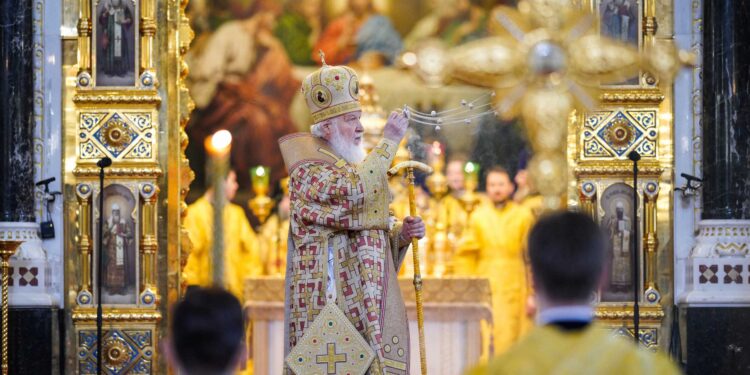
Monday, December 12, 2022

Explanation why MP is anti-Orthodox

  Re-sharing: Long but well worth reading: Explaining in detail what all is so VERY wrong & anti-Orthodox Christian, with the Stalin uncanonically founded in 1943, his still Putin & Kremlin-serving "Moscow Patriarchate" & its KGB head, Pat-Kyrill Gundayev  

  Time:  Mon, 12 Dec 2022

.

SHARED by an Orthodox Christian brother.


PLEASE SHARE THIS!-as it gives many answers as to this bizarre current Putin’s unjustified genocidal war against Ukraine and the Kremlin’s “religious” excuses for it, especially as Putin’s spiritual advisor “Patriarch” Kyrill strangely justifies it.


https://orthodoxtimes.com/orthodox-shahidism-and-moscow-patriarch-kirills-neo-pagan-theology-of-war/

“Orthodox Shahidism” and Moscow Patriarch Kirill’s neo-pagan theology of war

NewsRoom

“Orthodox Shahidism” and Moscow Patriarch Kirill’s neo-pagan theology of war

By Serhii Shumylo*

In his new anti-evangelical “theology of war,” Moscow Patriarch Kirill Gundyaev reaches a new low. Each time he issues a statement or gives a sermon, it seems that there is nowhere lower to go, but over the past six months, with each new sermon, this “priest of the pagan god of war” descends yet deeper into paganism and even Satanism. This time, justifying the mobilization in the Russian Federation in Putin’s  war against Ukraine and the Ukrainian people, the patriarch of Moscow voiced anti-Christian theses that, from the standpoint of Orthodox theology, fall under the concept of heresy.

On September 25, the Patriarch of Moscow deliberately manipulated and distorted the meaning and content of Gospel quotations. Taking them out of context, he delivered a heretical teaching from the standpoint of Orthodoxy. The essence of this teaching is that the Russian military commits a kind of “atoning sacrifice” and that in the event of a soldier’s death, this “sacrifice washes away all the sins that man has committed.” Moreover, he compared the mobilization (that is, the deliberate sending of his own people to their deaths) with the voluntary atoning sacrifice of Jesus Christ for the salvation of mankind.

Among other things, Patriarch Kirill Gundyaev stated the following from the pulpit: “For God so loved the world that He gave His only begotten Son (John 3:16). He gave Himself for what? To death! …Sacrifice is the greatest expression of the best of human qualities. We know that today many die in the fields of strife… The Church understands that if someone, moved by a sense of duty, by the need to fulfill an oath, remains faithful to his calling and dies in the performance of military duty, he is undoubtedly committing an act tantamount to sacrifice. He sacrifices himself for others.

And therefore we believe that this sacrifice washes away all the sins one has committed” (Sermon of September 25, 2022.

Even earlier, Patriarch Kirill of Moscow had similarly urged Russian servicemen: “Go bravely to fulfill your military duty and remember that if you have laid down your life for your homeland, for your friends, as the Holy Scriptures say, you will be with God in His kingdom, in His glory, in His eternal life”.

The day before Putin launched his war against Ukraine, on February 23, 2022, Patriarch Kirill Gundyaev once again made a special appeal and blessed the Russian army “to be ready to fight back against the enemy” “on the borders of our Fatherland”.

Two weeks after the outbreak of war, Patriarch Kirill declared: “we have entered a struggle which has not only physical, but metaphysical significance” (sermon of 6 March 2022). During the next eight months of the Russian war against Ukraine, he continued to formulate his own “theology of war” and “sacred” justification of Russian aggression against Ukraine in his messages and appeals.

Such statements and calls for “sacrifice” fundamentally contradict the spirit and letter of the Gospel and the Orthodox doctrine. After all, according to Orthodox doctrine, only repentance and communion wash away a person’s sins. No death “in the performance of military duty” (let alone in a war of aggression!) is automatically capable of atoning or washing away a person’s sins. No “indulgence” from the patriarch or Synod can provide this.

Such a war is “Cain’s mortal sin,” for which those who commit it are subject to ecclesiastical condemnation and excommunication. Therefore, if any “kingdom” is guaranteed to them, it is clearly not God’s (heaven), but the devil’s (hell). And comparing the deaths of the Russian military with the atoning sacrifice of Jesus Christ, to which God the Father sent His Son to atone for the sins of mankind, and the actual call for parents to give their children as willingly as they did to the “sacrifice that washes away all sins,” is blatant blasphemy and abuse. Such a dogmatic and doctrinal departure from Orthodox doctrine is unprecedented in the history of the Russian Orthodox Church (ROC).

The Shahidism of the “Russian World” and the “Orthodox Caliphate” of Patriarch Kirill

Clearly, the Patriarch of Moscow professes an unorthodox doctrine. He is creating some new heretical creed of his own, a doctrine contrary to the teachings of the Orthodox Church. In particular, the ideas of “atoning sacrifice” for fallen Russian soldiers he proclaims are nothing more than a borrowing of the ideas of shahidism from the radical-fundamentalist currents of the Islamic world, according to which a warrior (mujahid) who dies during a war with “infidels” (jihad) receives automatic forgiveness of sins and goes to “heaven”.

At the same time, the “guarantee” of entering “paradise” is the fight against “infidels,” and not against one’s own co-religionists, as is the case with Patriarch Kirill Gundyaev, who essentially calls for the destruction of his own Orthodox flock from the Ukrainian Orthodox Church of the Moscow Patriarchate (UOC MP).

It is worth noting that “shahidism” is not the ideology of all of Islam, but only of certain Islamist extremist political currents of the radical-fundamentalist variety, and is usually applied to suicide bombers. Consequently, it has nothing to do with Christianity and Christian sacrifice.

The Patriarch of Moscow has also made other non-Orthodox statements. For example, in justifying the aggressive policy of the Russian Federation as a “metaphysical struggle of good against evil”, he expressed an almost Islamic understanding of the meaning of forgiveness: “Forgiveness without justice is surrender and weakness. Forgiveness must therefore be accompanied by the indispensable preservation of the right to stand on the side of light” (sermon of 6 March 2022).

Not the Gospel truths of “love thy neighbour”, “do not kill”, “turn the other cheek”, “if we do not forgive, then God will not forgive us”, but an entirely different approach, unknown to the Gospel: “forgiveness without justice is surrender and weakness”. This thought, foreign to the teachings of Christ, is much closer to Islam: “Know that forgiving the one who wronged you is not always commendable” (Salasatul-usul Sharh of Sheikh Muhammad ibn Salih al-‘Usaymin, Tafsir, Sura 42, Ayat 40); “Forgiveness and reconciliation are acceptable only when they benefit the wrongdoer. But if the offender does not deserve forgiveness and it is appropriate to call him to account for the crime he committed, the Shariah does not call on the victim to forgive the offender” (Abd al-Rahman bin Nasir As-Saadi, Tafsir of the Koran, Sura 42, ayat 40).

How could the radical ideas of Islamic fundamentalism and shahidism penetrate the environment of the Moscow Patriarchate and its leader? If we analyze the actions and statements of Kirill Gundyaev as Moscow Patriarch, everything becomes obvious: he has long had an undisguised interest in Islam. According to his own confession, what attracts him most of all to Islam is that “the Muslim world is a strong world.”

According to Kirill Gundyaev: “We have a common moral basis: Orthodox and Muslims. It is important for us to work together to strengthen morality in society … Once our president was asked about the attitude of Orthodoxy to Catholic Christianity and Islam, and the president replied: “We, the Orthodox, are closer to Islam. And he was right,” the head of the Russian Orthodox Church continued, “in the sense that in terms of tradition and basics of moral life, we are closer to Islam today than some Western Christians, who are currently moving away from traditional morality”.

According to the Moscow Patriarch, he is attracted by the fact that, unlike political-correlated Western Christianity, Islam continues to maintain a “fairly concrete ethic” and an “uncompromising tradition.” In his opinion, Western Christianity, unlike Islam, is now experiencing a “deep crisis” because “the Church stops telling people clearly and distinctly what is good and what is evil, it stops being needed”.

At a meeting of the Supreme Church Council of the Russian Orthodox Church on March 26, 2021, Patriarch Kirill said: “We need to constantly monitor everything that happens in the sphere of church relations with Islam and make adjustments to this trajectory, filling our relations with new content if necessary. In the face of the increasing challenges of the secular world, it is important to strengthen our solidarity… We have many topics to work on together, and we must make use of the common interests arising from the social, political and cultural context in which we all find ourselves today. Therefore it seems necessary to develop interaction with Islam both in the countries of canonical responsibility of the Russian Orthodox Church and throughout the world”.

For this purpose, a special Expert Council for Interaction with the Islamic World was created and remains active under the Moscow Patriarchate; its members study and try to partially adopt the experience of the Islamic world. Specialists from the so-called World Russian People’s Council (WRPC), headed by Patriarch Kirill, are also engaged in developing an Islamic-Orthodox dialogue and studying the experience of Islamic civilization. Also at the initiative of the “Economy and Ethics” Council under the Moscow Patriarchate, in 2011 theologians and bankers began to study and discuss the experience of Islamic banking and the possibility of its introduction in Russia under the guise of so-called “Orthodox banking” as an alternative to Western standards and methods of banking.

As can be seen, the experts close to Patriarch Kirill Gundyaev, those who prepare reports, policy briefs, justifications and sermons for him, are seriously engaged in studying the experience of Islam in various spheres. Having themselves a penchant for militant fundamentalism, they choose the ideology of Islamic extremist political movements as an example to follow. This explains the fact that the newest hybrid ideology of the Moscow patriarch, among other things, also reflects borrowed fundamentalist ideas from the “Islamic world”, in particular such extremist movements as “Islamic State” (IS or ISIS) and others.

A prime example can be found in the statement of the late Archpriest Dmitry Smirnov, one-time chairman of the Patriarchal Commission on the Family, member of the Supreme Church Council of the Russian Orthodox Church and chairman of the Synodal Department of the Russian Orthodox Church for Cooperation with the Armed Forces and Law Enforcement Agencies of the Russian Federation (2001–2013): “The modern Muslim wants to die for his faith. He wraps dynamite around himself. Wherever his mullahs, ulemas tell him, he goes there and dies, blows himself up. He is ready to sacrifice himself! He is declared a terrorist! But that’s not why he does it, he wants to put fear into the world. …And why do these young men die? Because they don’t want to have a state ruled by pederasts”.

In fact, the term “Russian world” itself was introduced as a separate ideologeme along the lines of the “Islamic world.” The modern hybrid ideology of the “Russian world,” which is not original but contains many borrowings and plagiarism from similar ideologies and theories, has a number of features that are much closer to Islam than to Christianity. Among such borrowings is the idea of the “Russian world” as a special “megacivilization” with its own “traditional values,” “spiritual bonds,” and “sacred mission,” which distinguishes “the Russian God-bearing people” from all other peoples of the world and which opposes the “anti-civilization” of the West.

In essence, it is a borrowing of the Islamist fundamentalist idea of political unity of Muslims around the world regardless of national and racial differences to oppose the West. Proclaiming their mission to revive a single Islamic Caliphate and its global hegemony, return to the spiritual, moral and political ideals and traditional values of the Middle Ages, the Islamists extol the first Islamic state as a “sacred ideal country” and the ancestral home of the modern Islamic world.

Borrowing such individual notions and slogans from fundamentalist Islamist movements, modern ideologues of the “Russian world” have essentially attempted to transplant the ideas of the global Islamic Caliphate onto Orthodox soil. In the new Russian mythmaking, the ideal of the medieval holy Caliphate was replaced by the ideal of the so-called “Holy Russia.” As a result of this substitution of names and individual provisions and principles, a new hybrid ideology emerged, outwardly called “Orthodox,” but in practice bearing more resemblance to radical Islam than to Christianity.

A “hot mix” of neo-Nazi and neo-Fascist ideas

At the same time, it would be erroneous to perceive the teaching of Patriarch Kirill about a separate “Russian world” as a complete borrowing of fundamentalist ideas from the Islamic world. As already mentioned, this is not a purely original theory. It embodies borrowings from various quasi-religious ideologies and theories. His doctrine is a “rattling mixture,” a kind of “vinaigrette” in which doctrines and ideologemes that are sometimes opposed to one another are jumbled together. It thus often becomes blatantly un-Christian, and as a result, this mixture acquires the character of heresy.

In particular, elements of such disparate ideologies and platforms as neo-Nazism and neo-fascism, as well as old communist myths and ideas about the USSR as an “ideal country”, about a “united Soviet people”, about their opposition to “the world evil” in the person of a “collective West”, etc., were embodied in the ideology propagated by the patriarch of Moscow. Post-Soviet Russian society’s propensity for and demand for such artificial myths and ideologemes has created fertile ground for the spread and popularity of newly emergent pseudo-Orthodox fundamentalist ideas, which are nothing more than a modern transformed incarnation of neo-fascism, neo-Nazism, national communism and Islamist fundamentalism, recycled and adapted to the Russian post-Soviet mentality under Orthodox camouflage.

There is no place in this un-Christian ideology for Christ’s teaching that “My kingdom is not of this world” (John 18:36). It is these foundational words that Patriarch Kirill Gundyaev defiles, denies, and refutes with his actions. In contrast to these precepts of Christ, his new religious doctrine is based on the neo-pagan cult of worshipping the power and might of the earthly state and government, replacing the Gospel ideals of the “heavenly fatherland” (“the heavenly kingdom of God”) with the ideals of the “earthly kingdom” and secular power (“the prince of this world”), excessive idealization of the earthly state, endowing it with sacred qualities, popularizing the cult of war (“victory cult”) and the need to offer oneself as a voluntary sacrifice on the “altar of the Fatherland” in order to “restore its unified historical space”.

Instead of evangelical ideals, some special “spiritual essence”, “civilizational mission”, “traditional values” and “common space” of the peoples of the “Russian world” — regardless of nationality, language and culture — are confessed here, which, despite their existing differences, are interpreted as “spiritually united Russian people” (“God-bearing people”) and a separate “sacred megacivilization”, which must necessarily confront the West. In this case, no peoples of the former “single space” has the right to self-determination and separate existence. Where such a desire might appear, as in Ukraine, such a nation is declared corrupt and is subject to correction and annexation. A special heretical theory has been developed according to which the earthly entities Russia, Ukraine and Belarus are equated to the Holy Trinity, and therefore, “just as it is impossible to divide the Blessed Trinity: the Father, the Son and the Holy Spirit – it is One God – so it is impossible to divide Russia, Ukraine and Belorussia – it is together Holy Rus’”.

This spurious and heretical statement, falsely attributed to St. Lawrence of Chernigov (it was never expressed by the saint in reality), but which Patriarch Kirill Gundyaev likes to quote, is blasphemy and infringes upon the basic tenet of the Orthodox doctrine – the unity of the Divine Trinity. After all, if the three republics of the former Soviet Union were divided among themselves decades ago, it appears that the Holy Trinity can be divided in the same way…

Among other things, according to the patriarch of Moscow, the current “metaphysical struggle” is being waged by Russia in Ukraine, “so that by the power of God all these devilish thoughts may be eradicated from the minds of people who do not seek the spiritual unity of Holy Rus’, so that we all realise our responsibility to preserve the spiritual unity of the Russian world… I speak with courage within these walls the words “Russian world”, although I know that some forces in Ukraine demonise them… We use this word – with full responsibility, inner calmness and confidence in the rightness of our position… We are one people – the people of Holy Rus’… of one historical Fatherland, called Orthodox Rus’. For this we pray today, and to this we direct our labours today” (sermon of October 18, 2022).

Patriarch Kirill proclaimed one of the main missions of the ideology of the “Russian world” to be the “restoration of the unity of the historical space of the peoples of Holy Russia”, which is artificially endowed with some special sacred and eschatological meaning. In this case, the medieval myth-dream of an imaginary “heavenly Holy Russia”, which was personified by the hosts of saints, is now artificially transferred to a particular earthly state formation in the face of the Russian Empire/Soviet Union/Russian Federation, headed by strictly earthly rulers/leaders.

According to renowned Orthodox theologian Prof. Gallagher Brandon, “This ideology is a form of ethnoracial religious fundamentalism, with appeals to blood, land, faith, nation, people, language and tsar/leader. Like previous ethnocentrisms, it demonizes all who oppose it. And at the same time, in the logic of the ideology of the “Russian world” the West is a great adversary, a kind of “supreme demon. The ideology of the Russian world is the new Nazism, the Nazi ideology of the XXI century”.

According to Professor Brandon, in the ideology of the “Russian World” “there are many similarities with German Nazism and Italian Fascism in the call for a ‘Historical (= Great) Holy Russia'”, which likens it to neo-paganism.

This view of the “Russian World” doctrine is shared by more than 1,500 Christian theologians around the world, who have signed a joint Declaration of Doctrine on the “Russian World,” in which they condemn this new doctrine as unchristian. Thus, there is every reason to speak of the “Russian world,” as a new heresy, of the of which Patriarch Kirill Gundyaev is the heresearch.

The expansionist ideology of the “Russian world

After the collapse of the USSR and the dissolution of the Communist Party of the Soviet Union, the Moscow Patriarchate was the only structure whose leadership was closely linked to the KGB and also the only one that has not undergone significant transformation in the post-Soviet period, maintaining its influence over large parts of the former “united country”. Not surprisingly, the former leadership of the KGB assigned the ROC the role (instead of the former CPSU) of forming a new imperial ideology designed to preserve and strengthen the so-called “common civilizational space.”

Previous ideas of communist “messianism” were easily superimposed on Byzantine-imperialist soil. Instead of the old communist slogans, new ones are invented — about the “Russian world,” “Orthodox civilization” and the “unified space of Holy Russia,” based on the same mutilated dream-utopia of some “paradise on earth” and “ideal country,” which, just as in Soviet times, must confront the whole surrounding world of “hostile” countries.

A new ideological hybrid is being created, which should combine the ideas of old Byzantine, Tatar-Mongol Horde (“Eurasian”) and Russian imperialism with transformed Soviet-Communist ideologemes and even individual ideas borrowed from German Nazism and Italian fascism, as well as Islamic fundamentalism.
The reproduction of political-fundamentalist mythologies and their demand for them in certain strata of post-Soviet society was natural. For decades, the totalitarian consciousness of the Soviet people had been brought up on myths about “enemy images” and an “ideal majestic country”, different from the other — “bad” — world (the West). The Soviet myth of the “ideal country” was based on fear and hatred of Europe and America. This fear has not disappeared, finding a new realization in the militant ideology of the “Russian world.”

The laboratory for the development of the new fundamentalist doctrine of the “Russian world” was the so-called “World Russian People’s Council” (WRPC), established in 1993 at the initiative of Kirill Gundyaev, which under the auspices of the ROC brought together Russian religious and cultural figures, scholars and representatives of the diaspora, and most importantly, representatives of government, security and law enforcement agencies of the Russian Federation. Through this “laboratory,” the Russian Federation began to test and implement new ideas.

The Moscow Patriarch was proclaimed chairman of the WRPC by its statute. Until 2009, the chairman was Patriarch Alexey Ridiger, with Metropolitan Kirill Gundyaev as his deputy and the de facto head of the organization. When he became patriarch in 2009, Kirill Gundyaev also became chairman of the WRPC. For a long time, Kirill’s deputy in the WRPC was Archpriest Vsevolod Chaplin, known for his scandalous statements in support of nuclear war. Today, Kirill’s deputies are the odious Russian oligarch, owner of the Tsargrad TV channel and sponsor of terrorism in the Luhansk and Donetsk “People’s Republics,” Konstantin Malofeev, and one of the ideologues of the “Russian world,” Aleksandr Shchipkov, who is also first deputy chairman of the ROC Synod Department for Relations with Society and Media. These two figures are directly responsible for forming the ideology of the ROC.

The role of the ROC increased significantly in 2001 when its congress in the hall of church councils of the Cathedral of Christ the Savior in Moscow was personally opened by Vladimir Putin. At the same time, in December 2001 the Russian Orthodox Church Synod declared “useful the development of the activities of WRPC as a permanent union of public organizations with the active participation and spiritual guidance of the Russian Orthodox Church.”

The Chairman of the State Duma of the Federal Assembly of the Russian Federation, the First Deputy Chairman of the Government of the Russian Federation, the leadership of the Federation Council, the Presidential Administration, the Federal Security Service and the Ministry of Internal Affairs of the Russian Federation, the leaders of major political parties, heads of federal subjects, public and religious associations of the Russian Federation take part in the work of the organization.

As an active participant in the political and ideological processes in the Russian Federation, Kirill Gundyaev tried to promote and disseminate the new ideology he was creating, in particular to Russian Federation President Vladimir Putin and his entourage, thus influencing the formation of the aggressive imperial ideology of Putin’s regime.

The Kremlin’s order to develop the ideology of the “Russian world” was a reaction to the Ukrainian Orange Revolution of 2004. For Putin, the events in Ukraine and the complete failure of his political plans came as a shock. Frightened by the transfer of the Ukrainian experience to Russian soil, he began to look for support in a new imperial ideology and its propaganda. Kirill Gundyaev was one of those who prompted him in this way. So, even before he became Patriarch of Moscow, he began to attract and support various marginalized supporters of Russian imperial “messianism,” including those with outright fascist, neo-Nazi and occult views (Aleksandr Dugin and others).

In 2005–2007 the experts of WRPC developed a program entitled “The Russian Doctrine”, which, besides producing ideological slogans, announced specific tasks. Among these is the expansion of the Russian Federation in the “near abroad”, the seizure of the Crimea, Donbass and all of Ukraine. So, the war between the Russian Federation and Ukraine has been ideologically substantiated and prepared since at least 2005.

In 2006, this doctrine was “assessed by reviewers of the Moscow Theological Academy of the Russian Orthodox Church as not contradicting the spirit and teachings of Orthodoxy.” In 2007, the “Russian Doctrine” was adopted as the basis of the ideology of WRPC under the auspices of the ROC, with direct lobbying support from Metropolitan Kirill, then also head of the UOC MP. He personally presented the final version of the doctrine at the All-Russian convention of the “Young Russia” movement.

In this doctrine, presented and promoted by Kirill Gundyaev, the terms “Russian world”, “spiritual crosses”, “common historical space” and the like were introduced and tested within Russian society as a whole for the first time.

A few quotes from this document:

“A SYMBOL OF FAITH IN RUSSIA. Russia is to its people a spiritual symbol of the same order as God, the Church, and faith. The symbol of faith in Russia is the creed of the patriot, for whom Russia is the supreme jewel of his life. Agreeing with the symbol of faith in Russia makes all people believers in a certain sense – BELIEVES IN RUSSIA.”

“The concept of the space of Historical Russia, that is, the natural area of the Russian world (the present RF plus Russian ethnic enclaves — Tavria, Novorossia, the Narva region, Latgalia, Southern Siberia, Ciscarpathian Rus’, as well as the territories of complementary ethnic groups — Belarusians, Eastern Ukrainians, Transcarpathian Rusyns, etc.)” is officially proclaimed.

“Russia is entering the path of the Russian irredenta: the ideology of return and reunification of those territories of historical Russia, to which it has a historical and moral right and which it makes practical sense to return. For Russia, this applies primarily to Belarus, Ukraine and Kazakhstan.

“Russia must make a sharp reversal with regard to the states of the near abroad… It is necessary to recognize Russia’s rights to a number of territories. In the case of Ukraine, claims to Donbass and Tavria (Crimea) at a minimum.”

“The main principles of national security are the principles of… advance and expansion.”

All this paranoid nonsense occupies hundreds of pages and is freely available on the Internet.

Thus, as we can see, long before he became head of the Moscow Patriarchate, Kirill Gundyaev led the process of developing and promoting a special Russian militant-fundamentalist ideology, in which he tried to interest Putin and his entourage. This was probably the reason why, with Putin’s support, he was able to become head of the ROC in 2009.

At the same time, Kirill Gundyaev began regular propaganda raids in Ukraine to promote the idea of the unity of the “Russian world.” One of the first such attempts was made during the celebration of the 1020th anniversary of the Christianization of Kievan Rus’ in 2008. Then, during a rock concert on Kreshchatik in Kiev, Metropolitan Kyrill jumped out onto the rostrum and began hysterically chanting the slogan “Russia, Ukraine and Belarus are Holy Rus’!” Later, at a press conference in Moscow, he spoke about his first such experiment in Kiev: “It was like a meeting of liberators – there was such jubilation among Ukrainians”. He also noted at the time: “Recent days show that we Ukrainians, Russians, and Belarusians also understand the importance of preserving a single civilizational space called Holy Rus’”.

After becoming patriarch of Moscow in January 2009, Kirill Gundyaev made the ideology of the “Russian world” virtually the doctrine of the entire Russian Orthodox Church. According to him, “the core of the modern Russian world is Russia, Ukraine and Belarus,” but he also includes Moldova, Kazakhstan and some other former Soviet republics, which certainly need “the restoration of unity.” Only a united Russian world can become a strong subject of global international politics, stronger than any political alliances,” Patriarch Kirill of Moscow said at the opening of the 3rd “Assembly of the Russian World” in November 2009.

Since then, the manipulation of slogans about “united Holy Rus’”, a “united civilization space”, the “united Russian world”, “united spiritual crosses”, etc., has become systemic, being adopted not only in the ROC, but also in the power structures and special services of the Russian Federation.

In promoting the ideology of the “Russian world”, Moscow Patriarch Kirill Gundyaev often appeals to the terms “Holy Rus’” and “unified historical space of the peoples of Holy Rus’” as some kind of historical reality, although in fact it is only a folk metaphor, an imaginary myth-dream. Thus, it is not only illiterate from a scientific and historical point of view (in fact, there has never been a real country or state with the name “Holy Rus’”), but is a deliberate manipulation and substitution of concepts.

All of these ugly pearls still require careful study and analysis. But we can already say that the Patriarch of Moscow, according to his own convictions, is not Orthodox and is not a Christian. The big question is, is he a believer at all? And if so, what is he a believer in? By his own admission, he is attracted to the “strong world.” It is not surprising that in the mind of such a man the Christian sacrifice can be replaced by radical Islamist shahidism, the “sacred sacrifice” of his own people blasphemously compared with the atoning sacrifice of Christ, and in the mythology created by him under the name “Holy Rus’” we see the appearance of a pseudo-Orthodox “Caliphate” whose main mission is the voluntary or forceful union of countries and peoples forming the so-called “Russian world” in order to confront Western “anti-civilization”.

Patriarch Kirill Gundyaev was the one who formulated and presented Putin and his entourage with a new militant fundamentalist quasi-religious ideology, which was adopted by Putin’s regime in its aggression against Ukraine and which is now responsible for the genocide and deaths of tens of thousands of peaceful Ukrainian civilians, many of whom are Orthodox Christians.

In addition to private evaluations, heresy always requires condemnation by the Church at the council/synodal level. While such condemnation is not officially carried out, it means that a certain church community or the Church as a whole may share such views. So, World Orthodoxy must refute and condemn this heretical teaching of the Moscow patriarch. It is their moral and canonical duty. As Patriarch Kirill Gundyaev himself once stated, “if the Church stops telling people clearly and distinctly what is good and what is evil, it ceases to be necessary.”

Serhii Shumylo,
Ph.D. (History), Doctor of Theology (Th.Dr,)
Director of the International Institute of the Athonite Legacy,
Research fellow of the Institute of History of Ukraine at the National Academy of Sciences of Ukraine


4 news Items

Re-sharing: Death for some, after receiving a Covid 19 vaccination, and related serious medical study information  
  Time:   Sun, 11 Dec 2022 

 
Dick Morris: Tucker Carlson's Dangerous Pro-Russian Stance Continues
    Here is the Tucker speech that Morris is criticizing:
https://www.foxnews.com/opinion/tucker-carlson-point-ukraine-war-regime-change-russia
 

And this other article also:-more pro-Putin and anti-Ukrainian garbage false-news:


 Semi-"inebriated"/partially drunk, Dictator Putin's Ramblings-but very revealing about his insanity, enormous self-deception and lies, as alcohol opens his mouth, & he publically reveals his twisted illogical mind, better than any other influence could.  
  Time:   Fri, 9 Dec 2022   Putin is living in a false mental world of his own creation, not in the real world, which has been the typical mindset of all past world-wide mass-murdering power-mad dictators, who care nothing for the millions of fellow human beings who they cause to suffer and die.

Rennick's Amazing Vax Rant

   FW: Australian Senator Gerard Rennick's Amazing Vax Rant  

  Time:  Fri, 9 Dec 2022

Joanna, Another anti-Vax piece shared by Mother Abbess Juliana (Hazbun) in Chile.

It looks interesting.

Daniel


From: juvenalia Hazbun

Sent: Thursday, December 8, 2022 7:29 AM

To; Dan Everiss, and many others

Subject: Fwd: Australian Senator Gerard Rennick's Amazing Vax Rant


Australian Senator Gerard Rennick's Amazing Vax Rant Leaves Opposition Parties Angry


https://rumble.com/v1ytqx6-australian-senator-gerard-rennicks-amazing-vax-rant-leaves-opposition-parti.html


Sunday, December 11, 2022

Moscow Patriarchy continues to go crazy


 X2: Re-shared: 12/11/2022: English & Russian: The Moscow Patriarchy continues to go crazy 

  Time:  Sun, 11 Dec 2022


The Moscow Patriarchy continues to go crazy

Author: Internet Cathedral. Publication date:December 11, 2022. Category: Moscow Patriarchate .


In the "prayer books of the occupier" handed out by Russian clergy to Russian soldiers the other day, at the top of each page is a Calvary cross, but on both sides of it, instead of traditional spears and lips with vinegar, two Kalashnikov assault rifles are depicted as an instrument of torture of the Savior, symbolically depicting the killers of Christ as a lethal weapon.

In the text, Putin is referred to as an "archistrategos" with the following wording: "Give Victory to the Supreme Commander-in-Chief Vladimir, the courageous archangel and God-loving Ruler of Russia." True, the word "archistratig" is written with a small letter, in contrast to " Supreme Commander" and " Ruler of the Russian Victory." Obviously, it is rightly implied that he is not very significant, just as "courageous" is not quite. Yes, and the word "God-loving" with a small one. However, in such a simple way, ordinary soldiers are forced to pray for a person who "has not yet begun." What prayers will appear later, when it finally begins?

To this stupidity in the "prayer book" even the Mother of God is blasphemously added, Who, supposedly for the murderers, "sheds Her blood on the battlefield." Where did they get such pseudo-evidence, which is nothing but heresy? And it's all being printed today!

Not so long ago, Putin's comrade Kirill Gundyaev, not knowing how to squeeze closer to his idol, began to call the former "specific prince of the Leningrad gateway" in prayers by name and patronymic, as the most illustrious person. This is not surprising - one of the metropolitans of the UOC-MP once spoke about Putin in public, defending his "good name", that "this is our king and god." But, true, it was a long time ago, now this metropolitan is among the very first patriots of Ukraine.

It remains only to ask: What or Who  is God? IF such people are His believers.


В розданных на днях российскими священнослужителями российским же солдатам "молитвословах оккупанта", вверху каждой страницы изображён Голгофский крест, но с двух сторон от него, вместо традиционных копья и губы с уксусом, в качестве орудия пыток Спасителя изображены два автомата калашникова, символически изображающих убийц Христа в виде смертоносного оружия.

В тексте Путин именуется "архистратигом" с такой формулировкой: "Даруй Верховному Главнокомандующему Владимиру, мужественному архистратигу и боголюбивому Правителю Российскому Победу". Правда, слово "архистратиг" написано с маленькой буквы, в отличие от "Верховному Главнокомандующему" и "Правителю Российскому Победу". Очевидно, справедливо подразумевается, что архистратиг он не очень значительный, как и "мужественный" не вполне. Да и слово "боголюбивый" с маленькой. Тем не менее, таким нехитрым способом принуждают простых солдат молиться за человека, который "ещё не начинал". Какие же молитвы появятся потом, когда, наконец, начнёт?

К этой глупости в "молитвослове" кощунственно прибавлена даже Божия Матерь, Которая, якобы за убийц "кровь Свою на поле брани проливающая". Откуда они взяли такое псевдо-свидетельство, которая есть ничто иное, как ересь? И это всё печатается сегодня!

Не так давно товарищ Путина Кирилл Гундяев, не зная, как ближе притиснуться к своему кумиру, стал называть былого "удельного князя ленинградской подворотни" в молитвах по имени и отчеству, как светлейшую особу. Это не удивительно - один из митрополитов УПЦ МП как-то при людях отозвался о Путине, защищая его "доброе имя", что "это наш царь и бог". Но, правда, это было давно, теперь этот митрополит в числе самых первых патриотов Украины.

Остаётся только добавить: каков бог, такие у него и верующие.

Wednesday, December 7, 2022

Ivan Andreev: Catacomb Church in Soviet Russia

 English & Russian: historical evidence as to why we all must flee from Stalin's puppet "Moscow Patriarchy", as it is NOT genuine or canonical or grace-filled Holy Orthodoxy, but is part of these End-times mass world wide apostasy., & it is unrepentant  

  Time:  Wed, 7 Dec 2022  


And this totally Kremlin dependent religious-front institution, centered in Moscow, via its “Patriarch Kyrill”, is THE  highest church authority, over its two subservient American based captured daughter churches: “The Orthodox Church In America”:-the OCA/MP, and its sister church here, “The Russian Orthodox Church Abroad/MP”..


Ivan Andreev: About the Secret (Catacomb) Church in Soviet Russia

Author: Metropolitan Agafangel. Publication date:December 06, 2022. Category: ROCOR archive .

Metropolitan Agafangel's introduction

This report to the ROCOR Council of Bishops (typescript, no date, style and spelling of the original preserved) by prof. I.A. Andreev was discovered by me in the Synodal Archive in New York and was first published in Russian Sigor magazine No. 4-6 for 2009. Of particular interest in the cited report is the information that the new priest-martyr Met. Kirill (Smirnov), contrary to the disseminated information that he allegedly did not perform any consecrations, in fact, ordained not only priests for the Catacomb Church, but also bishops.


Ivan Andreev: Let us briefly recall the history of the events that preceded and determined the emergence of the Secret (Catacomb) Church in Soviet Russia.


St. Patriarch TIKHON, as is known, anathematized the Soviet government on January 19, 1918, and did not lift the anathema until his very death. The legitimate Local Church Council of the Russian Orthodox Church in Moscow on January 28, 1918 approved this anathematization. Since then, there has been no legal * Church Council in Soviet Russia, and therefore no one could remove the anathema from Soviet power. The illegal "assemblies" never raised the issue.


The anathematization of Soviet power by the Russian Orthodox Church had and still has great religious, moral and political significance. The Russian Church, politically separated by the Soviet State, religiously separated the Soviet State from itself by its act of anathematization. After that, the so-called "legalization" of the Orthodox Russian Church in an anathematized atheistic state became unthinkable from an ecclesiastical, moral, or political point of view.


The Orthodox Russian Church has become permanently persecuted. But, as is known from history, the Church grows from persecution, and martyrdom is the seed of Christianity. Led by the wise, meek and honest St. Persecuted by Patriarch TIKHON, the Russian Church grew and strengthened spiritually.


The "Red", "living", "Renovationist Church" was only a nightmare, "insurance" that frightened only the cowardly and revealed the evil ones. Among these faint-hearted and crafty should be included in Russia Metropolitan Sergius, and outside of Russia - those Eastern Patriarchs who recognized the "Red Church". In the spring of 1924, Ecumenical Patriarch Gregory of Constantinople tried to interfere in the affairs of the Russian Church in order to "reconcile" the old churchmen "Tikhonovites" with the Renovators "Zhivot". St. Patriarch Tikhon, of course, categorically opposed this attempt.


On June 16, 1922, Metropolitan Sergius (Stragorodsky), together with Archbishop Evdokim (Meshchersky) and Archbishop Seraphim (Meshcheryanov), on the occasion of the emergence of an unauthorized red renovationist “Church” and the renovationist V.Ts.U., announced: “Having considered the platform of V.Ts. .U. and the canonical legality of the Administration, we declare that we fully share the measures of the V.Ts.U., we consider it the only canonical legal supreme church authority, and we consider all orders emanating from it to be completely legal and binding. We urge all true pastors and believing sons of the Church, both entrusted to us and other dioceses, to follow our example.


This shameful act of Metropolitan Sergius aroused the indignation of all true and faithful Church hierarchs, clergy and laity, who showed neither cowardice nor cunning in the face of the nightmare of the "Red Church".


After the release of St. Patriarch TIKHON from prison On June 26, 1923, the nightmare of the "Red Church" dissipated like smoke. And then Metropolitan Sergius, immediately, “with extraordinary lightness in thoughts,” changed his “canonical convictions” and repented before the Church and the Patriarch for his retreat into renovationism and recognition of the “Red Church.” But, although after his repentance he again received from the hands of the Patriarch the episcopal mantle and white hood, the religious and moral reputation of Metropolitan Sergius in the eyes of true believers was hopelessly lost. St. Patriarch TIKHON, who before this event highly appreciated Metropolitan Sergius, no longer trusts him, and in his will of January 7, 1925, shortly before his death, he appoints his deputies: first - Metropolitan KIRILL (the most unshakable), the second - Metropolitan AGAFANGEL and the third - Metropolitan PETER. Metropolitan Sergius is no longer mentioned here at all.


Reasoning strictly canonically (as Protopresbyter Father M. Polsky rightly pointed out), after such a terrible and shameful fall of Metropolitan Sergius, it was impossible to finalize decisions about him only by the will of the Patriarch, but it was necessary, although he was allowed to serve, but left to the jurisdiction of the Cathedral , and even more so it was impossible to put him in the near future at the head of the Church. Metropolitan PETER made this huge mistake after his arrest. He appointed Metropolitan Sergius as his first deputy, Metropolitan Michael (Exarch of Ukraine) as his second, and Joseph as Archbishop of Rostov (later Metropolitan of Petrograd) as his third.


When Metropolitan Sergius became the head of the Russian Orthodox Church, Metropolitan Agafangel was released from prison. Metropolitan Agafangel quite legally asserted his rights, but then he himself renounced these rights and submitted to Metropolitan Sergius. This was also a big mistake of Metropolitan Agafangel.


In June 1927, shortly before the Judas betrayal of Metropolitan Sergius, Optina elder Fr. Nectarios, according to the testimony of professors Komarovich and Anichkov who personally visited him, said: “Metropolitan Sergius is a renovationist.” To the objection that Metropolitan Sergius was a renovationist, but later repented, Fr. Nektarios answered: "Yes, he repented, but the poison sits in him." The words of the perspicacious elder soon came true: on July 16/29, 1927, Metropolitan Sergius issued his famous “Declaration”, by which the Orthodox Russian Church was betrayed into the hands of the enemies of Christ. There was a terrible "legalization" of the Church of Christ by the anathematized Antichrist Soviet state, as a result of which the anathema proclaimed by St. Patriarch Tikhon and confirmed by the Moscow Church Council - fell on the "legalized" Church. From that time on, this Church began to be called the "Soviet Church".


After this declaration, a new Renovationist split took place, more terrible than the previous Renovationist split of 1922-1923. Metropolitan Sergius for the second time and already irrevocably stood up for the canonical defense of the Red Soviet Church. The persecution of true Orthodox Christians who did not recognize the declaration of Metropolitan Sergius, whom friends began to call "true Tikhonovites" and "Old Churchmen", and enemies - "Josephites" (named after Metropolitan Joseph of Petrograd), is beyond description. All churches where only Metropolitan Peter was commemorated and where Metropolitan Sergius was not commemorated began to be closed by the Soviet authorities with the help of Metropolitan Sergius. Metropolitan Sergius cruelly imposed his "bans" and by this gave the "prohibited" into the hands of the GPU.


The true Orthodox Russian Church had to withdraw into the catacombs.


The idea of ​​a catacomb church, according to the testimony of the first catacomb bishop Maxim (Zhizhilenko), was given by Patriarch Tikhon himself. At first, the Catacomb (or, as it was also called, secret, or desert) Church was united only in the name of Metropolitan Peter, and then was headed by Metropolitan Kirill. After the death of Metropolitan Peter and Metropolitan Kirill (in 1936), Metropolitan Joseph of Petrograd became the spiritual and administrative head of the Catacomb Church. Rare information that reaches us abroad is always obtained with the epigraph "not for your enemy we will tell the secret."


The Catacomb, secret, desert Church has a lot of enemies, not only in Soviet Russia, but also abroad. In view of this, the Catacomb Church, deeply honoring Metropolitan Anastassy personally and bowing down to him on earth, is afraid to reveal her secrets to the end and to name the names and whereabouts of her secret bishops.


At the present time there are several dozen secret bishops in Soviet Russia (according to information from Catholic sources, secret bishops in Soviet Russia: 30 according to some, and about 100 according to others). Each secret bishop is given the fullness of ecclesiastical authority. In return, the secret bishops granted extended rights to the secret priests in the localities.


According to the testimony of the Catacomb Bishop Maxim, who was shot in 1930, in 1928 the Catacomb Church anathematized the Soviet Church.


Some catacomb bishops and priests from Soviet Russia are now abroad, continuing to be "secret" here as well. If the Russian Catholic Church Abroad has to go into the catacombs, then these latter have already been prepared for her.


In August 1952, the Catacomb Russian Orthodox Church lost one of its most remarkable archpastors. In view of his death, it is permitted to mention his name and say a few words about the nature of his activities. This archpastor is Metropolitan John (of Altai), secretly consecrated by Metropolitan Kirill of Kazan. The late Metropolitan was abroad after World War II and during the period from 1946 to 1951. visited Soviet Russia several times and returned back. Until August 1952, his rare reports and messages, communicated to some catacombs from Soviet Russia abroad, were the main source of information in Abroad about life in Soviet Russia (about church life).


By the way, the late Vladyka John gave his blessing, if necessary, to unite all the former sub-Soviet catacombs abroad into one organization, “adopting it” (in the words of Vladyka himself) to the First Hierarch of the Russian Catholic Church Abroad, Metropolitan Anastassy.


The late Metropolitan John gave his blessing to pass on to all the former catacombs some extremely important instructions. At the present time, after the death of Vladyka, these instructions can be entrusted to the hierarchs of the Russian Church Abroad. These instructions are:


one). Of all the foreign Russian churches around the world, only the Catholic Church Abroad, headed by Metropolitan Anastassy, ​​is allowed to visit, pray in it and eat its sacraments.


2). All other Russian Churches Abroad (jurisdictions) are non-canonical.


3). The greatest lie, deceit and temptation is the preaching of "peace" coming from the Soviet Church on the directive of the Soviet government.


four). The greatest lie and temptation for foreign countries is the preaching of "unification of jurisdictions".


5). The unification of jurisdictions is possible only in the form of the return of schismatics, after repentance, to the bosom of the Catholic Church Abroad.


6). If at the Liturgy, next to the hitherto immaculate name of the First Hierarch of the Russian Catholic Church Abroad, Metropolitan Anastassy, ​​the name of “alien”, i.e. some bishop of another Russian jurisdiction (not belonging to the Catholic Church Abroad) and it turns out that this happened with the permission of Metropolitan Anastassy, ​​then the Catacomb Church invites its faithful children to immediately depart from Metropolitan Anastassy and seek the Catacomb Church abroad.


7). Metropolitan Anastassy, ​​like Patriarch Tikhon, heading an open, non-secret Church, cannot but make many compromises with the world (communication with the Eastern Patriarchs and with hierarchs, clergy and laity of other jurisdictions), but this should not go beyond a certain limit (always remembering example of St. Patriarch Tikhon and Metropolitan Sergius).


eight). But if a catacomb bishop had stood in the place of Metropolitan Anastassy, ​​then he, not being afraid to lose 85% of his flock (i.e., the flock of the Catholic Church Abroad), would have anathematized, first of all, the American Metropolis, now headed by Metropolitan Leonty. Part of the lost flock would be compensated by the influx of a new flock from D.P., who at the present time do not find it possible for themselves to be in the Catholic Church Abroad because of its compromises indicated above.


This is the disagreement (but not complete divergence) of the Catacomb Church with the paths of the Catholic Church Abroad. According to the Catacomb Church, sooner or later, the Catholic Church Abroad will have to either “pass the limit” (i.e. unite with schismatics, enter “under the omophorion of the Ecumenical Patriarch”, etc.), or be persecuted by the whole world and physically destroyed , or go into the catacombs, which are being prepared for her.


___________


With regard to the information received from Soviet Russia regarding the position of the Church, the following explanations should be given in this regard.


From 1950 to 1953 many tens of thousands defected from behind the Iron Curtain. But among these masses of the newest refugees, only dozens understand more or less exactly church affairs and can provide this or that information about the life of the Secret Catacomb Church.


They often run from behind the Iron Curtain, oddly enough, not the best, but the worst. The system of hostage-taking, the official law on the punishment of relatives of the fleeing (“traitors to the motherland”), and the actual incredible torture of these latter, stop the morally sensitive and do not stop the soulless, fleeing, despite the fact that they are well aware of the impending torture of their remaining relatives.


Over the past three years, only about 20 people have given one or another accurate and correct information about the life of the Secret Church in Soviet Russia (most of them had no relatives in Soviet Russia). The last witness to escape, a junior lieutenant, escaped from a Soviet prison in May 1953.


According to the information received, after the war (since 1946) it was allowed to open one church each in some cities. Since the bells could not be obtained, “beats”, rails, steel cylinders, etc. were adapted for ringing.


In 1946, both Komsomol members and party members went to open churches, but by 1951 they were gone. According to the last refugee (May 1953), an old church was opened in Gorlovka in 1947. which at first was attended very intensely, but then it turned out. that the priest was an open communist, a former graduate of the Soviet theological seminary. He kept lists of parishioners and used confessions for denunciations. Some parents had the imprudence to ask the prayers of this "priest" for their sons, who went abroad during the last war. These parents were soon summoned to the GPU. Similar revelations of communist priests, students of the Leningrad Theological Seminary and the Moscow Theological Academy were also in other places. There is information (from one priest and one monk who fled from Soviet Russia in 1945) that there were appointments


According to the unanimous testimony of more than ten witnesses who were fully versed in church affairs, in addition to services in open churches, there is an ever-increasing mass of secret services, especially in the villages. There are indications of these secret services in Soviet magazines and newspapers, which denounce "sectarians" and "schismatics" who perform the sacraments and do not recognize Patriarch Alexei. It is clear that these are not sectarians and not schismatics, but the catacombists of the Old Church. Incidentally, the Baptists in the Sov. Russia is officially allowed to arrange chapels, and there are especially many of them in Southern Russia.


From unverified sources, there is information that some catacomb priests, “on a special assignment,” are formally included in the clergy of the Moscow Soviet Patriarchate, which makes it very difficult to identify and persecute them. This information should be categorically rejected, because. The Catacomb Church cannot give such "tasks" suitable for the Jesuits.


_____________


According to information from Catacomb sources abroad, it is known that between the "Ecumenical" (Constantinople) and the Soviet Moscow Patriarch there is an agreement and an agreement "on spheres of influence" was concluded. According to this agreement, Europe before France should be in the sphere of the Moscow Patriarch, also England, her dominions (Canada, Australia, etc.), while America, France, Italy, the Middle East and the Mediterranean coast, in the sphere of the "Ecumenical" patriarch. All Soviet churches, according to this information, in the sphere of the "Ecumenical" patriarch will have to be abolished and transferred to the Exarchate of Constantinople. In the sphere of the Moscow Patriarch, on the contrary, everything should be under the strong hand of Moscow.


Prof. I.M. Andreev. 


Comments  

RE: Ivan Andreev: About the Secret (Catacomb) Church in Soviet Russia - Metropolitan Agafangel 05.02.2014 07:49

The report was in a folder with documents of the 1964 Bishops' Council.


__________________________


To view original Russian copy-paste to text editor and enlarge the text

Иван АндреевО Тайной (Катакомбнойцеркви в Советской России


АвторМитрополит АгафангелДата публикации: 06 декабря 2022. КатегорияАрхив РПЦЗ.


Этот доклад Архиерейскому Собору РПЦЗ (машинописьбез датыстилистика и орфография оригинала сохраненыпрофИ.ААндреева обнаружен мною в Синодальном архиве в Нью-Йорке и впервые был опубликован в журнале Русский Сигор №№4-6 за 2009 годОсобый интерес в приведенном докладе представляют сведения о томчто новосвященномученик митрКирилл (Смирнов), вопреки распространяемой информациичто онякобыне совершал никаких хиротонийв действительностирукополагал не только священников для Катакомбной Церквино и епископов.


Митрополит Агафангел


Напомним вкратце историю событийпредварявших и обусловивших возникновение Тайной (КатакомбнойЦеркви в Советской России.


СвПатриарх ТИХОНкак известноанафематствовал советскую власть 19.1.1918 ги до самой своей кончины анафемы не снялЗаконный Поместный Церковный Собор Российской Православной Церкви в Москве 28.1.1918 гутвердил это анафематствованиеС тех пор законногоЦерковного Собора в Советской России не былои анафемы с советской власти поэтому никто не мог снятьНезаконные же «соборища» никогда и не поднимали об этом вопроса.


Анафематствование советской власти Русской Православной Церковью имело и имеет огромное религиозноенравственное и политическое значениеПолитически отделенная Советским Государством Русская Церковь актом своего анафематствования религиозно отделила от себя Советское ГосударствоПосле этого так называемая «легализация» Православной Русской Церкви в анафематствованном богоборческом государстве стала немыслима ни с церковнойни с нравственнойни с политической точки зрения.


Православная Русская Церковь стала перманентно гонимойНокак это известно из истории, — Церковь растет от преследованийи мученичество есть семя христианстваВедомая мудрымкротким и честным свПатриархом ТИХОНОМ гонимая Русская Церковь росла и крепла духовно.


«Красная», «живая», «обновленческая Церковь» была только кошмаром, «страхованием», испугавшим лишь малодушных и выявившим лукавыхК числу этих малодушных и лукавых следует отнести в России митрополита Сергияа вне России — тех Восточных Патриарховкоторые признали «Красную Церковь». Весной 1924 гВселенский Константинопольский Патриарх Григорий пытался вмешаться в дела русской Церкви с целью «примирить» староцерковников «тихоновцев» с обновленцами «живцами». СвПатриарх Тихонконечнокатегорически восстал против этой попытки.


16 июня 1922 гмитрополит Сергий (Страгородскийвместе с архиепископом Евдокимом (Мещерскими архиепископом Серафимом (Мещеряновым), по поводу возникновения самочинной красной обновленческой «Церкви» и обновленческого В.Ц.У., объявили: «Рассмотрев платформу В.Ц.Уи каноническую законность Управлениязаявляемчто целиком разделяем мероприятия В.Ц.У., считаем его единственной канонической законной верховной церковной властьюи все распоряженияисходящие от негосчитаем вполне законными и обязательнымиМы призываем последовать нашему примеру всех истинных пастырей и верующих сынов Церквикак вверенных намтак и других епархий»…


Этот позорный акт митрополита Сергия вызвал негодование всех истинных и верных Церкви иерарховклира и мирянне проявивших ни малодушияни лукавства перед кошмаром «Красной Церкви».


После освобождения свПатриарха ТИХОНА из тюрьмы 26 июня 1923 гкошмар «Красной Церкви» рассеялся как дымИ тогда митрополит Сергийтотчас, «с легкостью в мыслях необыкновенной», изменил свои «канонические убеждения» и принес покаяние перед Церковью и Патриархом в своем отступлении в обновленчество и признании «Красной Церкви». Нохотя он после своего покаяния вновь получил из рук Патриарха архиерейскую мантию и белый клобук, — религиозно-нравственная репутация митрополита Сергия в глазах истинно верующих была безнадежно потерянаСвПатриарх ТИХОНдо этого события высоко ценивший митрополита Сергия, — больше уже ему не доверяет и в своем завещании от 7 января 1925 годанезадолго до своей кончинызаместителями своими намечаетпервым — митрополита КИРИЛЛА (самого непоколебимого), вторым — митрополита АГАФАНГЕЛА и третьим — митрополита ПЕТРАМитрополит же Сергий здесь уже не упоминается вовсе.


Рассуждая строго канонически (как на это справедливо указал протопресвитер оМПольский), после такого страшного и позорного падения митрополита Сергия нельзя было заканчивать решения о нем только волею Патриархаа надо былохотя и допустить его до священнослуженияно оставить подсудным Соборуи тем более нельзя было его ставить в ближайшее время в возглавление ЦерквиЭту огромную ошибку допустил митрополит ПЕТР после своего арестаОн наметил первым своим заместителем митрополита Сергиявторым — митрополита Михаила (экзарха Украиныи третьим — архиепископа Ростовского (позднее митрополита ПетроградскогоИосифа.


Когда митрополит Сергий встал во главе Русской Православной Церкви — из тюрьмы был выпущен митрополит Агафангелнамеченный еще самим Патриархом Тихоном вторымпосле митрополита Кириллакандидатом на местоблюстителя (третьим же был митрополит Петр). Митрополит Агафангел совершенно законно предъявил свои правано затем сам отказался от этих прав и подчинился митрополиту СергиюЭто также был большая ошибка митрополита Агафангела.


В июне месяце 1927 г., незадолго до иудиного предательства митрополита Сергияоптинский старец оНектарийпо свидетельству лично посетивших его профессоров Комаровича и Аничковасказал: «Митрополит Сергий — обновленец». На возражениечто митрополит Сергий был обновленцемно потом покаялсяоНектарий ответил: «Дапокаялсяно яд в нем сидит». Слова прозорливого старца вскоре сбылись: 16/29 июля 1927 гмитрополит Сергий выпустил свою знаменитую «Декларацию», которой Православная Русская Церковь предавалась в руки врагов ХристаПроизошла страшная «легализация» Христовой Церкви анафематствованным антихристовым советским государствомвследствие чего анафемапровозглашенная свПатриархом Тихоном и подтвержденная Московским Церковным Собором, — пала и на «легализованную» ЦерковьС этих пор эта Церковь стала называться «Советской Церковью». Легализованная советская церковь начала служить антихристовой властипомогая последней в преследовании техкто «Декларацию» митрополита Сергия не признал.


После этой декларации произошел ново-обновленческий расколболее страшныйчем предыдущий обновленческий раскол 1922-1923 ггМитрополит Сергий вторично и уже безповоротно встал на каноническую защиту красной советской церквиПреследования истинных православных христианне признавших декларации митрополита Сергиякоторых друзья стали называть «истинными тихоновцами» и «староцерковниками», а враги — «иосифлянами» (по имени Петроградского митрополита Иосифа), — не поддаются описаниюВсе церквигде поминали только митрополита Петра и не поминали митрополита Сергия, — стали закрываться советской властью с помощью митрополита СергияМитрополит Сергий жестоко накладывал свои «прещения» и этим выдавал «запрещенных» в руки ГПУ.


Истинной Православной Русской Церкви пришлось уйти в катакомбы.


Идея катакомбной церквипо свидетельству первого катакомбного епископа Максима (Жижиленко), была дана самим Патриархом ТихономПервое время Катакомбная (иликак ее еще называлитайнаяили пустыннаяЦерковь объединялась только именем митрополита Петраа затем возглавилась митрополитом КирилломПосле смерти митрополита Петра и митрополита Кирилла (в 1936 г.) духовным и административным главой Катакомбной Церкви стал Петроградский митрополит Иосифрасстрелянный именно за это в 1938 гПосле смерти митрополита Иосифа Катакомбная Церковь свято хранит тайну имен и местопребывания своих духовных вождейРедкие сведениядоходящие до нас в зарубежьеполучаются всегда с эпиграфом «не бо врагом Твоим тайну повем».


Врагов у Катакомбнойтайнойпустынной Церкви очень многоне только в Советской Россиино и в ЗарубежьеВвиду этого Катакомбная Церковьглубоко чтя лично митрополита Анастасия и «земно ему кланяясь», опасается открыть до конца свои тайны и назвать имена и местопребывание своих тайных епископов.


В настоящее время в Советской России имеется несколько десятков тайных епископов (по сведениям из католических источниковтайных епископов в Советской Россиипо одним — 30, а по другим — около 100). Каждому тайному епископу предоставлена вся полнота церковной властиВ свою очередьтайные епископы предоставили расширенные права тайным священникам на местах.


По свидетельству катакомбного епископа Максимарасстрелянного в 1930 г., — Катакомбная Церковь в 1928 ганафематствовала советскую церковь.


Некоторые катакомбные епископы и священники из Советской России находятся ныне в Зарубежьепродолжая быть «тайными» и здесьЕсли Зарубежной Соборной Русской Церкви придется уйти в катакомбы, — то эти последние для нее уже приготовлены.


В августе 1952 гКатакомбная Русская Православная Церковь потеряла одного из своих замечательнейших архипастырейВвиду его смерти разрешается назвать его имя и сказать несколько слов о характере его деятельностиЭтот архипастырь — митрополит Иоанн (Алтайский), тайно хиротонисованный митрополитом Кириллом КазанскимПокойный митрополит находился после 2-й мировой войны в Зарубежье и за период с 1946 по 1951 ггнесколько раз побывал в Советской России и возвратился обратноЕго редкие доклады и посланиясообщаемые некоторым катакомбникам из Советской России в Зарубежье — до августа 1952 гявлялись главным источником информации в Зарубежье о жизни в Советской России (о церковной жизни).


Между прочимпокойный Владыка Иоанн благословилв случае надобностиобъединиться всем бывшим подсоветским катакомбникам в зарубежье в одну организацию, «усыновив ее» (по выражению самого ВладыкиПервоиерарху Русской Соборной Зарубежной Церкви — митрополиту Анастасию.


Покойный митрополит Иоанн благословил в свое время передать всем бывшим катакомбникам некоторые чрезвычайно важные указанияВ настоящее времяпосле смерти Владыкиэти указания могут быть доверительно переданы иерархам Русской Зарубежной ЦерквиЭти указания следующие:


1). Из всех зарубежных русских церквей по всему миру только Соборную Зарубежную Церковьвозглавляемую митрополитом Анастасиемразрешается посещатьмолиться в ней и питаться ее таинствами.


2). Все остальные русские зарубежные Церкви (юрисдикции) — неканоничны.


3). Величайшей ложьюобманом и соблазном является проповедь «мира», исходящая из советской церкви по директиве советской власти.


4). Величайшей ложью и соблазном для зарубежья является проповедь «объединения юрисдикций».


5). Объединение юрисдикций возможно исключительно только в форме возвращения раскольниковпосле покаянияв лоно Соборной Зарубежной Церкви.


6). Если на Литургиирядом с непорочным до сих пор именем Первоиерарха Русской Соборной Зарубежной Церкви митрополита Анастасия будет вознесено имя «чужого», т.екакого-нибудь епископа иной русской юрисдикции (не принадлежащего Соборной Зарубежной Церквии выяснитсячто это произошло с разрешения митрополита Анастасия, — то в таком случае Катакомбная Церковь предлагает своим верным чадам немедленно отходить и от митрополита Анастасияи искать Катакомбную Церковь зарубежом.


7). Митрополит Анастасийподобно Патриарху Тихонувозглавляя открытуюне тайную Церковь, — не может не идти на многие компромиссы с миром (общение с Восточными Патриархами и с иерархамиклиром и мирянами иных юрисдикций), но это не должно переходить известного предела (памятуя всегда пример свПатриарха Тихона и митрополита Сергия).


8). Но если бы на месте митрополита Анастасия стоял бы катакомбный епископто онне побоясь потерять 85% своей паствы (т.епаствы Соборной Зарубежной Церкви), — анафематствовал бы в первую очередь Американскую митрополиювозглавляемую ныне митрополитом ЛеонтиемЧасть потерянной паствы была бы возмещена приливом новой паствы из Д.П., которые в настоящее время не находят для себя возможным состоять в Соборной Зарубежной Церкви из-за ее компромиссовуказанных выше.


В этом заключается разногласие (но не полное расхождениеКатакомбной Церкви с путями Соборной Зарубежной ЦерквиПо мнению Катакомбной Церквирано или поздноСоборной Зарубежной Церкви придетсяили «перейти предел» (т.еобъединиться с раскольникамивойти «под омофор Вселенского патриарха» и т.п.), или быть гонимой всем миром и физически уничтоженнойили уйти в катакомбыкоторые ей и приготовляются.


____________


Что касается сведенийполученных из Советской России относительно положения Церквито по этому поводу следует дать следующие разъяснения.


С 1950 по 1953 ггмного десятков тысяч перебежало из-за «железного занавеса». Но среди этих масс новейших беженцев только десятки разбираются более или менее точно в церковных делах и могут сообщить те или иные сведения о жизни Тайной Катакомбной Церкви.


Бегут из-за «железного занавеса» частокак это ни странноне лучшиеа худшиеСистема заложничестваофициальный закон о наказаниях родственников бегущих («изменников родины») и фактические невероятные пытки этих последних, — останавливают морально чутких и не останавливают бездушныхбегущих несмотря на точто прекрасно знают о грядущих пытках оставшихся их родственников.


За три последних года только около 20 человек дали те или иные точные и правильные сведения о жизни Тайной Церкви в Советской России (большинство из них не имело родных в Сов.России). Последний по времени бегства свидетельмладший лейтенантбежал из советской тюрьмы в мае 1953 г.


По полученным сведениямпосле войны (с 1946 г.) было разрешено открыть в некоторых городах по одной церквиТак как колоколов нельзя было достатьто для звона приспосабливали «била», рельсыстальные баллоны и т.п.


В 1946 гв открытые церкви ходили и комсомольцыи партийцыно к 1951 гих уже не сталоПо сообщению последнего беженца (май 1953 г.), в Горловке в 1947 гбыла открыта старая церковькоторая сначала посещалась очень усиленноно потом выяснилосьчто священник был открытый коммунистбывший воспитанник советской духовной семинарииОн вел списки прихожан и использовал исповеди для доносовНекоторые родители имели неосторожность просить молитв этого «священника» о своих сыновьяхперешедших во время последней войны заграницуЭтих родителей вскоре вызвали в ГПУПодобные разоблачения священников-коммунистоввоспитанников Ленинградской Духовной Семинарии и Московской Духовной Академии были и в других местахИмеются сведения (от одного священника и одного монахабежавших из СовРоссии в 1945 г.), что бывали назначения, «в порядке партийной дисциплины», специалистов по антирелигиозной пропаганде в Духовные Семинарии для «усовершенствования».


По единодушному показанию свыше десяти свидетелейвполне разбиравшихся в церковных делахкроме богослужений в открытых церквахсуществует и все увеличивается масса тайных богослуженийособенно по деревнямОб этих тайных богослужениях имеются указания и в советских журналах и газетахобличающих «сектантов» и «раскольников», совершающих таинства и не признающих Патриарха АлексеяЯсночто это не сектанты и не раскольникиа староцерковники-катакомбникиМежду прочимбаптистам в СовРоссии официально разрешено устраивать молельни и таковых особенно много в Южной России.


Из непроверенных источников имеются сведениячто некоторые катакомбные священники, «по особому заданию» формально входят в клир Московской Советской Патриархиичто очень затрудняет их выявление и преследованиеЭти сведения должны быть категорически отвергнутыт.кКатакомбная Церковь таких «заданий», годных для иезуитов, — давать не может.


_____________


По сведениям из Катакомбных источников Зарубежья известночто между «Вселенским» (Константинопольскими Советским Московским Патриархом имеется договоренность и заключено соглашение «о сферах влияния». По этому соглашению Европа до Франции должна быть в сфере Московского Патриархатакже Англияее доминионы (КанадаАвстралия и др.), тогда как АмерикаФранцияИталияБлижний Восток и побережье Средиземноморья, — в сфере «Вселенского» патриархаВсе советские церквипо этому сведениюв сфере «Вселенского» патриарха должны будут упраздниться и перейти в Экзархат ЦарьградаВ сфере московского патриарха — наоборотвсе должно быть под крепкой рукой Москвы.


ПрофИ.М.Андреев


Интернет Собор / Internet Sobor

 Печать  E-mail

     Назад

·        Вперед 

Комментарии   


# RE: Иван АндреевО Тайной (Катакомбнойцеркви в Советской России — Митрополит Агафангел 05.02.2014 07:49


Доклад находился в папке с документами Архиерейского Собора 1964 года.


from Joanna's notepad:

earlier translation from 2014

https://remnantrocor.blogspot.com/2014/02/secret-catacomb-church.html