TWO articles: 1) St. Met. Filaret: "Shameful Silence In The Face Of Blasphemy" and 2) More: KGB Vladimir POPOV, Part III: "KGB & ROCOR"Inbox |
| ||||||

Respect or disrespect for me, by yourself Mark Kotlaroff, or by anyone, is meaningless to me.
Do we respect God and His commandments? - do we obey His SAINTS?, that is all that matters.
But may you wake up before you are suddenly and without warning, called to the next world and your judgement.
No matter what may be your excuses/reasons for... to being a leader of your uncalled for and illicit schism,
nothing I have read as your group's 'reasons' for turning against Met. Agafangel, 'dismissing him' (!), make any sense at all, or are the truth.
Soviet-style, you are slandering a righteous bishop... which is the communist's normal way of overthrowing their clerical foes, and thus then taking over dioceses, parishes, monasteries, people, and earthly riches and influence – the passing goods of this decaying world.
Money and power and property – earthly power and glory – those are your only real motives for breaking the former unity of our N. American continued ROCOR.
Thus what you and your co-workers have created, perhaps unwittingly, is but one more, Protestant sect in America. You are Protestant rebels, not humble or true Orthodox Christians.... which in Orthodoxy, is ruled and directed by Apostolic-Empowered consecrated BISHOPS.... not any 'democratic majority voting' or whims of changing doctrines, as with the other Protestants.
Therefore, you and your deluded co-workers, are not in any way or degree, a part of the Universal Apostolic Orthodox Church.
Mark! whether you consciously are motivated by a devotion to Putin, his captive MP and his 'Russian World' myth... or not, YET your unjustified schism is a joy to him and "Pat. Kyrill".
You are de-facto, doing their will. Perhaps too, some leaders among your group are conscious pro-Putin agents? Many think so. I do.
Since the demonic anti-human godless communists took over old Russia, they have been bent on world-domination, which includes gaining full control of former-diaspora Russians and their clergy.... which goals they have been and still are, remarkably successful with.
You are aiding their cause, not of genuine or holy Orthodoxy.... not of preaching or spreading Christ's Good-News, His Holy Gospel of the Salvation of mankind – which is THE reason for The Church to exist at all.
Before you die and have to leave this BRIEF-TIMED transitory world of lies and delusions, may God grant you and your rebel co-horts to repent.... what we all must do, to live with God and His saints in Heaven.
Make peace with Vladyka Agafangel.
THAT is my prayer and my expression of MY true respect...... for you.
With only goodwill and solicitous care for your welfare,
retired Rd. Daniel Everiss... as I prepare for my own soon coming passage from this fallen world, 'With the hope of the Resurrection'
From:letmish@aol.com<letmish@aol.com>
Sent:Thursday, August 6, 2020 7:16 AM
To:oregdan@hotmail.com<oregdan@hotmail.com>
Subject:Re: TWO articles: 1) St. Met. Filaret: "Shameful Silence In The Face Of Blasphemy" and 2) More: KGB Vladimir POPOV, Part III: "KGB & ROCOR"
respectfully remove me from your list
Sent:Thursday, August 6, 2020 7:16 AM
To:oregdan@hotmail.com<oregdan@hotmail.com>
Subject:Re: TWO articles: 1) St. Met. Filaret: "Shameful Silence In The Face Of Blasphemy" and 2) More: KGB Vladimir POPOV, Part III: "KGB & ROCOR"
respectfully remove me from your list
From:Dan Everiss <oregdan@hotmail.com>
Sent:Thursday, August 6, 2020 1:10 PM
Subject: -TWO articles: 1) St. Met. Filaret: "Shameful Silence In The Face Of Blasphemy" and 2) More: KGB Vladimir POPOV, Part III: "KGB & ROCOR"
Sent:Thursday, August 6, 2020 1:10 PM
Subject: -TWO articles: 1) St. Met. Filaret: "Shameful Silence In The Face Of Blasphemy" and 2) More: KGB Vladimir POPOV, Part III: "KGB & ROCOR"
Metropolitan Filaret: Shameful silence in the face of blasphemyAuthor: Metropolitan Agafangel. Publish Date: . Category:Archive of the ROCOR

I want to tell you about one case that happened not so long ago, and that would have been hard to imagine a few years ago -- but now as we're going downward more and more.
One person came from Paris and described an incident at a so-called "ecumenical meeting". Of course, you know what ecumenism is: it wants to completely destroy the essence of the Orthodox Church as the guardian of the Truth and create some new, strange church.
That's how this "ecumenical meeting" went. The so-called Orthodox proto-priest from the Paris Theological Institute, a Jewish rabbi, a Protestant pastor and a Catholic priest were present. At first they seemed to pray, and then the speeches began. And then, I'm sorry to say such things from the holy amvon, but I want to show you what we've come to: the Jewish rabbi said that the Lord Jesus Christ was the illegitimate son of a depraved woman...
But that's not the main horror. The Jewish people have been resisting God for a long time, so this is not surprising. But the horror was that when he said it, everyone else there was silent. Later, a man who had heard this terrible blasphemy asked the Orthodox proto-priest, "How could you be silent? You can't insult a rabbi, but you can insult the Virgin Mary!" Look at the state we've come to! How often does this happen to all of us, now that we have no courage to rise, when necessary, to defend our sanctuary! An Orthodox cleric should zealously rebel against blasphemy, just like St. Nicholas, when he stopped the mouth of a heretic ...
But now, unfortunately, we have become, as they say, "shamefully indifferent to both evil and good." And it is on the basis of this indifference, a kind of sense of self-preservation, that the heresy of ecumenism has established itself - as well as apostasy. This retreat is becoming increasingly apparent ...
Let us remember, brethren, that Christian love encompasses everything in itself, is compassionate to all, wants everyone to be saved, and humbles us, is merciful, and loves every creation of God; but where she sees a conscious attack on the truth, she turns into a fiery jealousy that cannot stand blasphemy. And it should always be so, because every Orthodox Christian should be zealous for God.
(from a sermon of Bishop Filaret, translated into English)
Метки: рпцз, митрополит филарет
ПечатьE-mail
I want to tell you about one case that happened not so long ago, and that would have been hard to imagine a few years ago -- but now as we're going downward more and more.
One person came from Paris and described an incident at a so-called "ecumenical meeting". Of course, you know what ecumenism is: it wants to completely destroy the essence of the Orthodox Church as the guardian of the Truth and create some new, strange church.
That's how this "ecumenical meeting" went. The so-called Orthodox proto-priest from the Paris Theological Institute, a Jewish rabbi, a Protestant pastor and a Catholic priest were present. At first they seemed to pray, and then the speeches began. And then, I'm sorry to say such things from the holy amvon, but I want to show you what we've come to: the Jewish rabbi said that the Lord Jesus Christ was the illegitimate son of a depraved woman...
But that's not the main horror. The Jewish people have been resisting God for a long time, so this is not surprising. But the horror was that when he said it, everyone else there was silent. Later, a man who had heard this terrible blasphemy asked the Orthodox proto-priest, "How could you be silent? You can't insult a rabbi, but you can insult the Virgin Mary!" Look at the state we've come to! How often does this happen to all of us, now that we have no courage to rise, when necessary, to defend our sanctuary! An Orthodox cleric should zealously rebel against blasphemy, just like St. Nicholas, when he stopped the mouth of a heretic ...
But now, unfortunately, we have become, as they say, "shamefully indifferent to both evil and good." And it is on the basis of this indifference, a kind of sense of self-preservation, that the heresy of ecumenism has established itself - as well as apostasy. This retreat is becoming increasingly apparent ...
Let us remember, brethren, that Christian love encompasses everything in itself, is compassionate to all, wants everyone to be saved, and humbles us, is merciful, and loves every creation of God; but where she sees a conscious attack on the truth, she turns into a fiery jealousy that cannot stand blasphemy. And it should always be so, because every Orthodox Christian should be zealous for God.
(from a sermon of Bishop Filaret, translated into English)
Метки: рпцз, митрополит филарет
ПечатьE-mail
Subject:More: POPOV, Part III
RUSSIAN original text:
KGB Lieutenant Colonel Vladimir Popov: KGB and ROCO 3
Author: Metropolitan Agafangel. Publish Date: . Category:History of the Russian Orthodox Church..
Notes of the former KGB lieutenant colonel: "Gifts of the Magi" as an active event of the Special Services of the Russian Federation in Ukraine
One of the authors of the book "KGB plays chess" and former employee of the State Security Committee of the USSR Vladimir Popov recently completed work on his memoirs. In the book "Conspiracy of scoundrels. Notes of the former KGB lieutenant colonel" he tells about the formation of the regime of Russian President Vladimir Putin, his associates, his work in the committee and key events to which the Soviet special services were involved. Previously, the book was not published. With the author's consent, GORDON exclusively publishes chapters from it. In this part Popov writes about Russian monarchists and their role in the Ukrainian events of early 2014.
Gifts of the Magi were exhibited in Kiev-Pechersky laurel in January 2014. Photo:churchs.kiev.ua
 Vladimir POPOV
Vladimir Yakunin
In 2006, the board of trustees of the Andrei First-Called Foundation was headed by Vladimir Yakunin, president of the Russian Railways (Russian Railways). Yakunin is an informal leader of the "Orthodox Chekists" who are gradually increasing their influence in Russia. Like Gazprom, Russian Railways is a kind of state in a state with 1.3 million employees, its own media empire, a budget of 1.3 trillion rubles and 30,000 armed police.In his 2006 book The Russian School of Geopolitics, Yakunin refers eight times to Russian nationalist Alexander Dugin. He is also listed as the editor of two Dugin anthologies published by Yakunin's Center for Problem Analysis and Public Administration Design.
Speaking about Dugin's seminar "Russia and the West" held at the center, Yakunin pointed out the main value of Dugin's approach, from his point of view: he sees the fundamental conflict of the modern era not in the struggle for energy sources or for economic domination, but in the clash of civilizations.
This idea of a civilizational watershed haunts Yakunin, who controls at least three non-profit organizations (including the Center for National Glory) that spread the values of Russian Orthodoxy, Russian history and ties with the Slavic world.
Since 2004, Yakunin annually holds congresses of Russian conservatives - church and state leaders - under the name "Dialogue of Civilizations" in an Orthodox monastery on the island of Rhodes. Dugin almost always participates in these conventions. "We work on the same pipeline," Yakunin said of Dugin in an interview.

Vladimir Yakunin. Photo: Yuri Golovin / wikipedia.org
Yakunin was born on June 30, 1948 in the city of Melenki in the Vladimir region. In 1972 he graduated from the Leningrad Mechanical Institute with a degree in Aircraft Manufacturing.
Then he was enrolled in the 101st school, which prepared personnel of Soviet scouts (after the death of Yuri Andropov received the status of an institute named after him). At the end of the two-year training, Yakunin was sent to the 1st department of the USSR's OCGB in the Leningrad region.
He worked under the guise of an engineer, senior engineer of the State Committee of the Soviet Council of Ministers on foreign economic relations, head of the department of the Institute of Physics and Technology named After Abram Ioffe AN USSR. Yakunin's activities at that time related to the sphere of interests of management of "T" (scientific and technical intelligence) of the SOVIET KGB PSU.
In 1985, he was enlisted in the central apparatus of the Soviet intelligence and under diplomatic cover sent on a foreign trip to the United States, where he served as secretary of the permanent representative of the USSR to the United Nations.
In early 1991, Yakunin returned to Leningrad. And in April 1991, together with a group of friends, he created a firm to attract foreign investment - AOST "International Center for Business Cooperation." In addition, he joined the board of directors of the bank "Russia" brothers Mikhail and Yuri Kovalchuk. This bank was created also with the money of the CPSU.
In 1991, the Leningrad Regional Party, which participated, like all the governing bodies of the CPSU, in pouring money into various structures, outwardly unrelated to the party, transferred to the bank a deposit deposit for a very considerable sum for those years - 50 million rubles.
In addition, Yakunin was a member of the board of directors of the Baltic Shipping Company and the Europa Hotel. State Duma deputy Gennady Gudkov , a former officer of the 2nd Service of the CRIMINALS for the city of Moscow and the Moscow region - said in an interview about Yakunin that "Yakunin never went into business" but "worked "under the roof" and was engaged in security."
However, Yakunin was not the only one involved in security in the "1990s. In 1992, The Company, which he headed, was at the centre of a parliamentary investigation into "the misuse of federal government funds". Along with Yakunin, Vladimir Putin, Yuri Kovalchuk and Vladimir Kumarin (Barsukov), one of the leaders of the so-called Tambov YPG, who was also a good friend of Putin, were involved in that scandal.
In June 2008, during the detention by police of several Russian citizens in Spain, the media attention was again drawn to earlier publications on Putin's ties in the 1990s with the head of the Tambov YPG Kumarin, who was arrested in August 2007 on charges of leading this criminal group and subsequently convicted. It should be noted that the practice of "misuse of budget funds allocated by the federal government" will be used by Yakunin throughout his career in the russian state structures.
At the same time, the facts became public, which showed the illegal acquisition of a number of leaders of St. Petersburg City Hall and large businessmen dachas in the village adjacent to Komsomol Lake, and the creation of a summer cooperative "Lake". Among the lucky owners of elite land on the shore of a beautiful lake and neighbors on dachas were Yakunin, Putin, Yuri and Mikhail Kovalchuki.
In August 1996, Putin was transferred to Moscow to work as deputy manager of the Russian president's affairs. On March 26, 1997, he was appointed deputy head of the Russian Presidential Administration and head of the General Control Directorate of the President of the Russian Federation. Almost immediately after that, Yakunin was appointed to the post of head of the Northwest District Inspectorate of the General Control Office of the Presidential Administration.
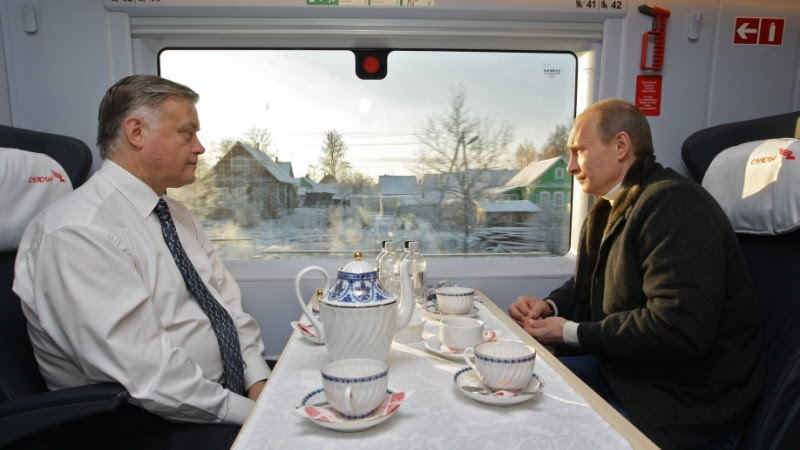
Vladimir Yakunin and Vladimir Putin. Photo: navalny.com
In July 1997, Yakunin received a report note from Vasily Kabachinov, The Auditor General of the Audit office of the Russian Ministry of Finance. On eight pages, the auditor detailed the illegal operations of the leadership, whose financial successes were directly involved deputy mayor of St. Petersburg Putin and his subordinate Dmitry Medvedev.
At the end of the audit, it was stated that the construction and finance corporation "Twenty Trust" owed the budget of St. Petersburg the sum of 28 billion 455 mmn 700,000. rub. "By reporting the above, we send the verification materials to conduct an investigation within your competence," Kabachinov wrote.
There was no investigation, and in October 2000, six months after Putin was elected president of Russia, Yakunin was appointed to the post of deputy transport minister of the country, and four months later became the head of the Russian Railways.
In September 2016, The deputy head of the "T" department, the General Directorate of Economic Security and Anti-Corruption (GUEBIC) of the Russian Interior Ministry, Colonel Dmitriy Sakharchenko, was arrested to this day. He was charged with receiving a bribe of 7 million rubles.
During a search of the apartment of the half-sister of the house, a room with a metal door was found, which had to be opened with special equipment. There was money in the room: $120 million in bank packages, and €2 million. The total weight of the currency was 1200 kg. He could not explain the origin of this money. He also could not explain where his relatives' accounts in Switzerland received $300 million, and another $16 million - to the accounts of his friend in several Moscow banks.
During the investigation, it was found that the money was accumulated by the businessman, who "sitting" on contracts of the Russian Railways and "subsidiaries" of the Russian Railways Yakunin. He was a full partner of the people who received contracts from the Russian Railways.
On March 5, 2013, Yakunin, as chairman of the board of trustees of the Andrei First-Called Foundation and the Center for National Glory, registered the Foundation for the Trust Capital "Origins." The director of the Istok Foundation was put already mentioned by us Sergey Shcheblygin. In terms of the amount of trust capital formed, the fund quickly entered the top five in Russia, and Yakunin and Shcheblygin were awarded the highest award of the Jerusalem Orthodox Church - the Order of the Holy Sepulchre of the Lord.
On July 23, 2013, Yakunin and his wife Natalia founded the "endowment" of the Andrei First-Called Foundation in Geneva. The stated task of the "endowment" is to support the research and preservation of the Russian national heritage, as well as to promote the peaceful coexistence of different peoples and religions. Natalia Yakunina became president of the foundation; Yakunin is vice-president. Yakunin's colleague in his past intelligence activities, staff intelligence officer Mikhail Ilyich Yakushev, also joined the board of the Swiss structure.
Mikhail Yakushev
Since 2004, Yakushev has been the first vice-president of the Andrei First-Called Foundation and the Center for National Glory. Information about it in open sources, as it should be for people of this profession, is extremely stingy. The website of the Imperial Orthodox Palestinian Society turned out to be the most reliable source of information about the Soviet/Russian intelligence officer and reported on Yakushev the following:
Mikhail Yakushev is a Ph.D. candidate in history, oriental historian, Arabist, Ottoman, and translator of the Arabic language at the highest level. He is a graduate of the Institute of Asian and African Countries at Moscow State University. He worked in the diplomatic field in Tunisia and Israel. He is the author of more than 30 scientific and non-fiction works on the history of Eastern Orthodoxy and the Russian political-diplomatic and spiritual presence in the Ottoman Empire. Winner of the Metropolitan of Moscow and Kolomensky Makariya (Bulgakov) Memory Award. He is a member of the Imperial Orthodox Palestinian Society.
And now more details. Yakushev was born on November 26, 1959. He studied at the secondary school No.5 of Dolgoprudny in the Moscow region. He graduated from Moscow State University (Institute of Asian and African Countries) named after Mikhail Lomonosov. Upon completion of his education at the university, he was enrolled in the 101st School (the future KGB Institute named after Yuri Andropov), which is an educational institution of Soviet/Russian foreign intelligence. As a rule, after receiving higher education, checked state security agents and children of the Soviet party elite were enrolled there. Yakushev's relatives were not among the latter.

Mikhail Yakushev. Photo: menswork.ru
In 1988, Yakushev was sent on a foreign trip under diplomatic cover to the Soviet Embassy in Tunis. From 1994 to 1999, he served as the first secretary of the Russian Embassy in Israel, then was listed as an advisor to the Russian Foreign Ministry. From May 2002 to April 2003, Yakushev was the chief of staff of the Federation Council Committee on International Affairs.
In an interview, Yakushev reported the following:
"I was the first October in the class, the first pioneer and the first Komsomol. In the army I joined the candidates for the CPSU, in 1979 was admitted to the party. Moreover, in the army I was the head of a circle to study the biography of Vladimir Lenin... After the army on the third attempt I managed to enter the Institute of Asian and African Countries at Moscow State University at the Faculty of History and Philology, and there I very often passed the history of the party. For me, the subject "History of the CPSU" has always been a very easy subject...
First time in Jerusalem... I found myself in december 1994. Then I was sent by the first secretary to work at our embassy in Tel Aviv, and I served as a diplomat at our embassy from November 15 to May 30. And he was engaged in the kind of service (this was my load) communication with the Jerusalem Patriarchate. But this load has become my favorite thing. Then there was Patriarch Diodor, by the way, the cavalier of the international award of Andrei the First-Called "For Faith and Loyalty."
... He was engaged in Russian real estate issues. We managed to get a paper from the Ministry of Foreign Affairs on re-registration from Soviet real estate to the Russian one in October, because the collapse of the Soviet Union is a blow again. These are the claims of Ukraine, first of all, on the part of this church real estate. In general, the Israelis also thought for a long time how to be...
The position of Yasser Arafat (an agent of influence of the foreign intelligence of the KGB of the USSR), who supported the Moscow Patriarchate, also helped. Maybe even too cool took, because he had an argument with his wife Sukhoi on this issue, because he stood up for the position of Patriarch Alexis."
Website "Orthodoxy and Peace," April 23, 2013
The Foundation of Vasily the Great and Konstantin Malofeev
"Orthodox oligarch" Konstantin Malofeev in January 2007 became the founder and chairman of another Orthodox foundation - the Vasily the Great Foundation. The general director of this fund was zurab Chavchavadze, Malofeev's ideological father and, like Malofeev, a convinced monarchist.Like the author of the Russian triad, "Orthodoxy, Autocracy, Nation" count Sergei Uvarov, who created gymnasiums in Russia, where the sovereign servants were brought up, Malofeev created the Orthodox gymnasium of St. Basil the Great, headed by zurab Chavchavadze. Malofeev's stated goals of creating a gymnasium completely coincided with Uvarov's - to raise the future Russian elite.
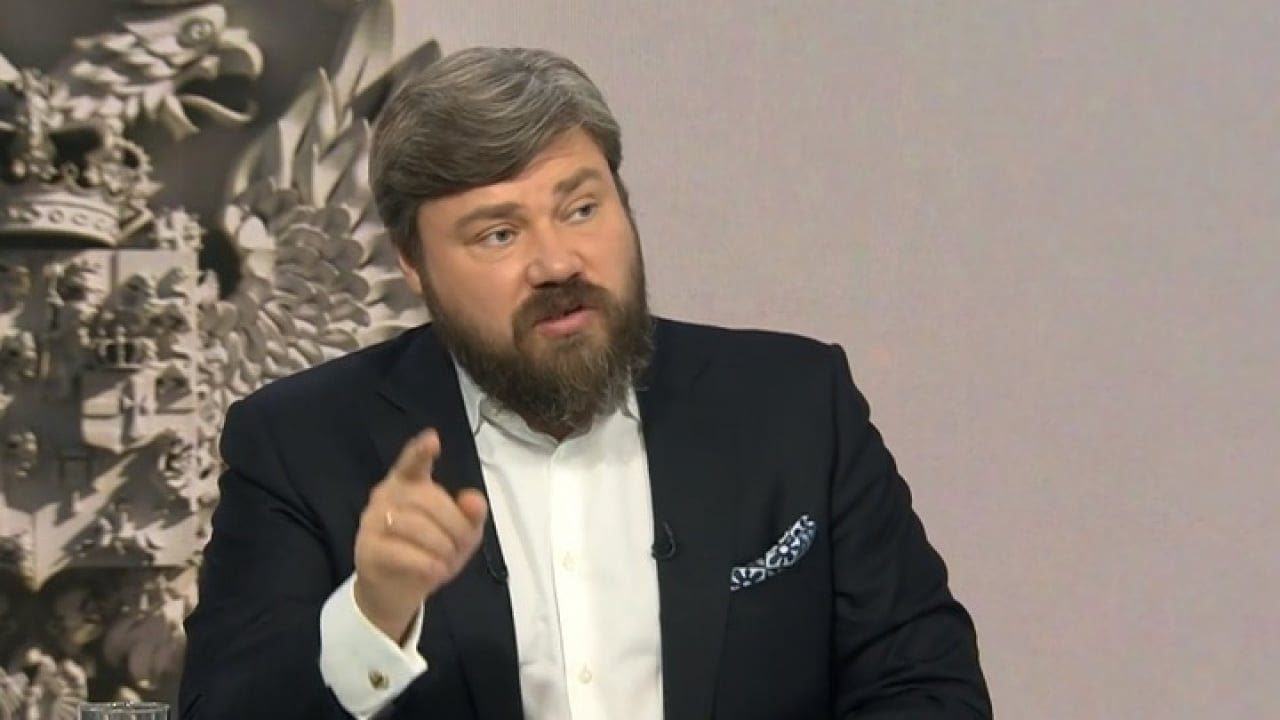
Konstantin Malofeev. Photo:mnews.world
Vladimir Yakunin, a member of The Country's closest circle of President Putin, was another active figure of the "deep state" and Malofeev's mentor. Because of his closeness to the President, Yakunin had the opportunity, acting in the interests of the "deep state," to indirectly influence Putin's decisions. In his turn, Malofeev for many years maintained friendly relations with Igor Shchegolev, who since 2000 held the position of head of the press service department, first acting president, and then President Putin. Since May 2012, he has become an assistant to the Russian president.
From Chavchavadze's memoirs we learn a lot about the undeclared goals and activities of the Vasily the Great Foundation, which, together with its organizers, was actively involved in the preparation of the Russian invasion of Ukraine. Chavchavadze writes:
"We talked a lot with Igor "Strelkov-Girkin" together with Konstantin Malofeev, explained our positions, because we had to cooperate when Strelkov even before the Crimean events poured into our structure, when he came to work at our Foundation Basil the Great. He immediately aroused sympathy for me and Constantine, with whom we exchanged our impressions at once.
We talked to him in a lot of fun, found a lot in common. It turned out that Strelkov is a monarchist, and Konstantin Malofeev and I are monarchists convinced, as they say, with experience. I have known Konstantin for a long time, since I passed to him, a 15-year-old boy, the answer to his letter to the Grand Prince Vladimir Kirillovich. I was an active participant in the monarchy movement at that time. And against the background of all the quarrels and squabbles in the monarchical environment sincere and pure position of young Bones just bribed me. I realized that he is a real monarchist. In short, for me Kostya is a native man. And here we are saying with him: what an amazing man Igor Strelkov!"
Here is what journalist Oleg Kashin writes about Malofeev:
"All my interlocutors described Malofeev in the same way - yes, he is sincerely and seriously obsessed with spirituality, power, military history... back in the 1990s, he was an active Orthodox figure in St. Petersburg, communicated with the late Metropolitan John (Sychev), who at that time had a reputation as an open fascist (the closest associate of Metropolitan Konstantin Dushenov, who served in prison on the 282nd, "extremist" article), and after the death of Metropolitan Malofeev from church affairs departed, made friends with Alexander Dugin, then with someone else to the beginning of the 10th year. turned into the brightest representative of the social group "Orthodox businessmen."
According to people familiar with him, there may be questions about how he earns his money, but there are no questions about how he spends it... A man who is willing to spend any money to make Russia look like the one "we lost."
Igor Strelkov (Igor Vsevolodovich Girkin) was born on December 17, 1970 in Moscow. He graduated from the Moscow State Historical and Archives Institute. He had a long-standing intelligence as an agent of the FSB. In this capacity he participated in military operations in Transnistria, Bosnia and Chechnya.
Igor Girkin and Alexander Borodai. Photo: ERA
During the Bosnian war he began to cooperate with the newspaper "Tomorrow" where he met Alexander Borodai. Later, they visited various hotspots in Russia together and published material about them in the newspaper "Tomorrow".
In 1998, Girkin was enlisted in the FSB of Russia as a positively proven agent of special services. In 2011 he was a correspondent of "ANNA-NEWS" in Abkhazia. At a press conference on July 10, 2014, he said that he was a colonel of the FSB and resigned on March 31, 2013.
After his dismissal from the service in 2013, Girkin, on the recommendation of Beard, was hired by the Marshall Capital investment fund, which was owned by Malofeev. Bearded and Malofeev, in turn, connected long-term, with youthful time, friendship. In the Malofeev Foundation, Borodai was engaged in PR actions, and Girkin was entrusted with security issues.
Alexander Boroday was born on July 25, 1972 in Moscow. He graduated from the Faculty of Philosophy of Moscow State University. He took part in one of the fighting groups in the events of September - October 1993 in Moscow on the side of the Supreme Council of the Russian Federation, at a press conference on July 10, 2014 said that he fought in Transnistria. Since the mid-1990s he has been published in the newspaper "Tomorrow" and is engaged in PR and political consulting. At the time of the war in Ukraine, he was a PR consultant and headed the Internet TV channel "Day TV".
Strelkov and Borodai were born and raised in Moscow, received a humanitarian education and had nothing to do with Donbass. At a press conference on July 10, 2014, Strelkov and Boroday said that they met in 1996 at the apartment of their friend, who was not named. Olga Kulygina was a friend.

Ольга Кулыгина. Фото: E.N.O.T. CORP / YouTube
Olga Kulygina was born on September 14, 1972. He lives with his 77-year-old mother and 19-year-old son in Moscow. In 1989-1994 she studied at the Moscow State Institute of Applied Biotechnology (when it was received, the institute was called differently: the Moscow Institute of Technology of the Meat and Dairy Industry).
In 2001, the same institute defended her Ph.D. thesis on "Hematological and cytogenetic consequences of the Chernobyl accident for three species of mouse-like rodents living in the exclusion zone." She worked for Oleg Deripaska's Basic Element.
An expert of the World Anti-Criminal and Anti-Terrorism Forum, created by former Russian Interior Minister Anatoly Kulikov. Journalist of the ANNA news agency, registered in Abkhazia and headed by Marat Musin.
In 2012, she traveled to Syria, where she wrote pro-Assad material, accusing the rebels of all mortal sins. In October 1993, she participated in the events at the White House in Moscow, was a paramedic of the detachment C20 (commander - Colonel Yeremin). Her immediate boss in the White House was a colonel in the Yakushenkov medical service. In 2001, Yakushenkov and Kulygina had a son. Yakushenkov died in 2012, he was 25 years older than Kulygina.
On May 30, 2014 (most likely, everything happened three days earlier) in the area of the checkpoint "Biryukovo" Ukrainian border guards detained two minibuses "Gazel" moving from Russia. On the Ukrainian side they were met by Mercedes-Vito. A battle ensued, during which five terrorists were killed and 13 were detained, one of them was seriously wounded. The vehicles were carrying 28 Kalashnikov assault rifles, six machine guns, four sniper rifles and three Fly grenade launchers, as well as 40 boxes of ammunition and grenades.
Among the passengers of one of the "Gazelles" was Kulygina, who was carrying $10,000. For some time she was in the SBU detention center in Kiev. Shortly before her arrest, the media published a photo of Kulygina with a Kalashnikov assault rifle in her hands in Slovyansk, captured by pro-Russian extremists led by Strelkov-Girkin.
In addition, her joint photos with Girkin were widely known. In many publications Kulygin was called his combat girlfriend. Kulygin was introduced to Girkin Beard, with whom she has been friends since defending the White House in 1993. From the same time she knew Sergei Shcheblygin. The unifying beginning for all these people was hatred of liberal values and proximity to the special services of Russia.
"Gifts of the Magi" as an active event of special services
In early 2014, shortly before the Crimean events, the Gifts of the Magi, the greatest shrine of the Christian world, were delivered to Ukraine, which had never left their places of storage in Saint Athos in Greece. The event was organized and financed by the Malofeev Foundation. In Ukraine, they worshipped more than 400,000. Man.The shrine was accompanied by employees of the Malofeev Foundation, Alexander Borodai and Igor Girkin, who was formally the head of the relic protection. At that time these names were not known to anyone.
Delivery of the Gifts of the Magi to Ukraine coincided with the protracted political crisis, which became known as Euromaidan. On February 20, 2014, blood was spilled in Kiev. The next day, Ukrainian President Viktor Yanukovych left Kiev. There was a change of power in the country.
There are serious reasons to believe that the action to bring the shrine to the territory was in fact an active event of the Russian special services and had not only propaganda, but also intelligence purposes. In Kiev, Daram bowed 280,000. people, in Simferopol - 50 thousand, in Sevastopol - 100 thousand. Man.
As Malofeev later stated, 100 thousand. Sevastopol residents prayed for the return of Crimea to Russia. According to him, everyone was talking about the possibility of annexation of Crimea to Russia at that time, including Sergei Aksenov, a deputy of the Supreme Council of the Autonomous Republic of Crimea, and Vladimir Konstantinov, chairman of the top state body of Crimea.
Immediately after the end of the action with the Gifts of the Magi in early February 2014, Malofeev assisted the device of Alexander Borodai PR consultant Aksenov.
In the documentary "Crimea. Putin said the following:
"It was the night from February 22nd to 23rd, finished around 7am and I let everyone go and went to bed at 7am. And, parting, I will not hide, parting, before all separated, I all my colleagues, and there were four of them, said that the situation unfolded in such a way in Ukraine, that we are forced to start work on the return of Crimea to Russia ... but he immediately stressed that we would do it only if we were absolutely convinced that the people who live in Crimea want it. It turned out that those wishing to join Russia there are 75% of the total. You understand, a closed survey was conducted, outside the context of a possible affiliation."
Putin did not see fit to explain what was meant by the concept of "closed poll." Closed poll was the action of Malofeev with the bringing of the Gifts of the Magi to Ukraine and, in particular, to Crimea. The initiative of the "Orthodox Chekists" in Crimea became a special operation of the special services of the Russian Federation - a provocation that predetermined Russia's invasion of Ukraine.In the wake of Crimean success on the night of April 11th to April 12, 2014, Girkin, who has a wealth of experience fighting in illegal armed groups, invaded the 52-man vanguard on the territory of the Donetsk region of Ukraine and captured the small town of Slovyansk, marking the beginning of the Russian takeover of the regions of Eastern Ukraine, where he covered himself with an old agent's habit of hiding himself with a pseudonym and became known as Strelkov.
In an interview with the nationalist writer zakhar Prilepin on the Tsargrad TV channel belonging to Malofeev, on February 20, 2017, Borodai stated that the action in southeastern Ukraine had not been coordinated with the political leadership of Russia, so he was forced to make frequent visits to Moscow for the necessary consultations.
This is hard to believe for many reasons, especially since the deputy head of the Russian government and agent of the 5th Directorate of the KGB of the USSR Dmitry Rogozin on Twitter on May 24, 2014 unequivocally expressed his support for the invaders and wrote that "I would change now, without hesitation, all his positions for the good fortune to be now in the same trench with the defenders of Slavyansk."
However, Rogozin did not give up his posts and did not climb into the trench. And Strelkov eventually fled Slovyansk, abandoning his men, military equipment, and even the authentic documents of his fighters. Having moved to Donetsk, where the flame of war followed him, he, according to the testimony of beard's now-former friend, stayed in a bunker until he was transferred to Russia.
The previous part was published on July 29. Next will be released on August 12.
Source
Tags: KGB
ПечатьE-mail
Comments
#RE: Подполковник КГБ Владимир Попов: КГБ и РПЦЗ ч.3—Митрополит Агафангел05.08.2020 10:28
Unfortunately, in Ukraine (and not only in Ukraine) now there are only two political forces within which all existing political parties are distributed here - pro-Western and pro-Kremlin.
Pro-Western is the creation of a separate Ukrainian state, like Poland, with its (not Russian) language and culture, and as different as possible from Russian culture. Here all Russian emperors are criminals, and the Russian Empire, supposedly, was engaged exclusively in the destruction of Ukraine. All parties ofa nationalist and liberal nature belong to this direction, which sees in the future Ukraine backward (but original) raw appendage of more developed countries.
The pro-Kremlin direction is trying to return Ukraine to the USSR, where instead of communism fake Orthodoxy and everything controls the FSB-KGB. Which is no better than a "pro-Western perspective."
Unfortunately, there are no independent pro-Ukrainian forces (such as the force that Hetman Skoropsky tried to form and strengthen) in Ukraine.
The above article is written in a "pro-Western" spirit, where the word "monarchist" is almost an expletive. It is a pity, the tendentiousness significantly reduces the quality of the material submitted, and many people who are not Ukrainian nationalists, the "antiheroes" of this article, contrary to the author's plan, will cause, rather, sympathy.
Pro-Western is the creation of a separate Ukrainian state, like Poland, with its (not Russian) language and culture, and as different as possible from Russian culture. Here all Russian emperors are criminals, and the Russian Empire, supposedly, was engaged exclusively in the destruction of Ukraine. All parties ofa nationalist and liberal nature belong to this direction, which sees in the future Ukraine backward (but original) raw appendage of more developed countries.
The pro-Kremlin direction is trying to return Ukraine to the USSR, where instead of communism fake Orthodoxy and everything controls the FSB-KGB. Which is no better than a "pro-Western perspective."
Unfortunately, there are no independent pro-Ukrainian forces (such as the force that Hetman Skoropsky tried to form and strengthen) in Ukraine.
The above article is written in a "pro-Western" spirit, where the word "monarchist" is almost an expletive. It is a pity, the tendentiousness significantly reduces the quality of the material submitted, and many people who are not Ukrainian nationalists, the "antiheroes" of this article, contrary to the author's plan, will cause, rather, sympathy.